
For Artists
"We curate commitment, not careers."
Museum For A Rainy Day is a curated museum. Selection is based on the integrity, quality, and coherence of your work -- not on sales history, resume, or follower count.
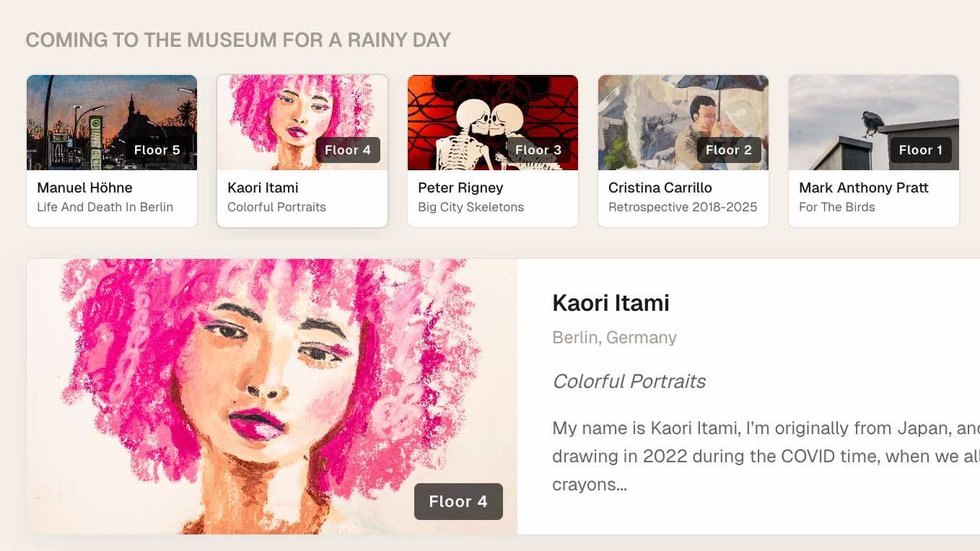

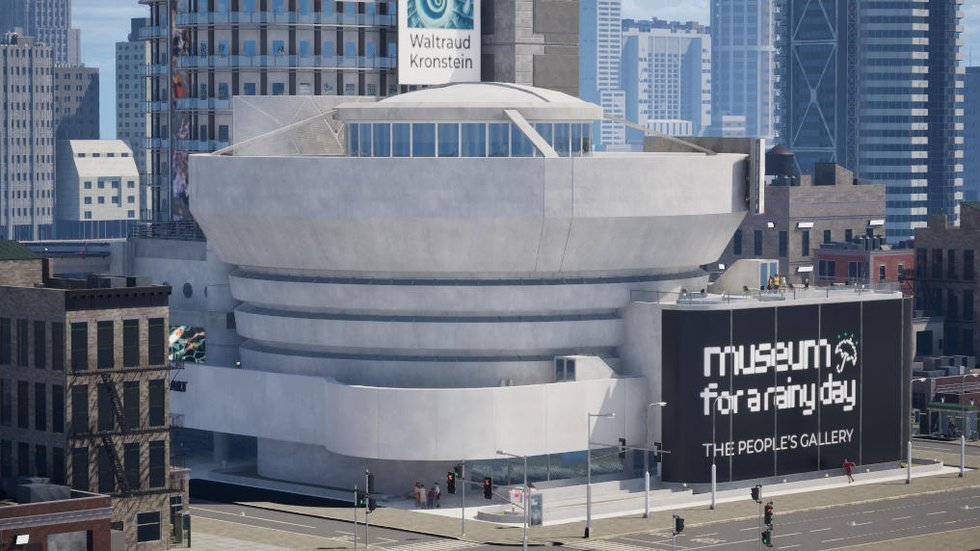
The People's Gallery
The People’s Gallery is a curated exhibition space within the Museum For A Rainy Day.

Curatorial Process & Submission
How the People’s Gallery is curated, how submissions are reviewed, and the principles guiding selection.

GROW - The Artist Commons
GROW is the artist commons where artists assemble complete galleries and submit them for curatorial review.
Is this for you?
Yes, if...
- You make work consistently over time.
- You revise and refine; decisions feel intentional.
- You can present a cohesive set of work (a gallery), not only isolated pieces.
Also yes, if...
- Self-taught or formally trained.
- Never sold a piece -- or sold many.
- Practice is quiet, private, or outside networks.
Probably not a fit, if...
- Casual uploads with no intent to refine.
- Purely derivative / trend imitation.
- Looking for a marketplace rather than curation.
Not a fit does not mean not an artist.
What we don't judge
- Commercial success (sales / pricing)
- Credentials (degrees / institutions)
- Visibility (followers / press)
- Representation / awards
How submissions work
Step 1
Have the following ready:
- Contact information and biography for verification
- 24 images prepared for review (under 15 MB per PNG)
Step 2
Create a gallery in GROW (free). Submit for curatorial review. Each gallery is considered individually; status is shown in your dashboard.
Step 3
Accepted galleries are scheduled and exhibited in The People's Gallery within the Museum.
Exhibition details
Accepted media
The People's Gallery accepts image-based works. Selected exhibitions are presented using one of the Museum's designated formats.
Original work requirement
Only original works are eligible. The Museum does not accept:
- AI-generated or AI-assisted artwork
- Works that substantially replicate existing copyrighted material
- Submissions where authorship cannot be clearly established
Frequently asked questions
I'm not a professional. Should I submit?
We do not use “professional” status as a criterion. The People’s Gallery reflects the reality that there is an extraordinary amount of committed, high-quality artistic practice taking place outside of formal market visibility. Many artists create continuously, develop coherent bodies of work, and sustain a serious practice over time — regardless of whether that work circulates commercially, institutionally, or informally. The Museum for a Rainy Day exists to provide a curated context in which such work can be seen, encountered, and understood as art.
If I'm not accepted, does that mean I'm not good?
No. Inclusion reflects curatorial alignment with the People’s Gallery framework and does not constitute a judgment of artistic worth. After one year, artists are welcome to present a new gallery for consideration, reflecting the evolution of their practice. This time-based approach reflects the Museum’s belief that artistic practice develops over time, and that such development is central to what the Museum seeks to foster and present.
Why is it called The People’s Gallery?
The People’s Gallery reflects the reality that artists come from many backgrounds, work in many conditions, and participate in cultural life in different ways. A museum that aims to represent artistic practice across regions and communities cannot limit itself to artists defined solely by professional status or market participation. Inclusion in The People’s Gallery is therefore not determined by whether an artist is “professional,” but by the quality, coherence, and seriousness of the work presented. Curation remains central. Every gallery is reviewed individually, and selection reflects curatorial alignment with the exhibition framework of the Museum.
How do you define quality?
Curatorial consideration includes artistic originality and intent, coherence and clarity of presentation, and suitability for exhibition within a virtual museum environment. We look at how the works operate together as a complete presentation.
Selected artists are granted a dedicated gallery space within the Museum at no cost.